Crystal Singing Bowls: Sizes, Frequencies, and What They Actually Do to a Room
A crystal singing bowl is a pitched instrument, not a treatment.
A crystal singing bowl is a pitched instrument, not a treatment. It rings one clear fundamental note, and across the crystal lines I can verify, those fundamentals land roughly 180 to 600 Hz (ravensounds.com). That’s pitch. It tells you nothing about what the bowl does to your body.
Below I set out the sizes, the frequency range, what one actually sounds like in a room, and who should think twice before buying. You’ll also find price, the Tibetan versus crystal question, and where to try one near you.
Spec box: frequency range, volume, size, weight, price band
Frequency
Across the crystal singing bowl lines I can verify, fundamentals land roughly 180 to 600 Hz (ravensounds.com). Other published charts extend the full crystal range to about 110 Hz to 880 Hz depending on bowl size and tuning (thalira.com). Both describe pitch, not effect. A bowl at 440 Hz is flexing in and out 440 times per second (ravensounds.com).
Size and pitch
Pitch falls with the square of the radius, so widening a bowl by about 40% drops it a full octave (ravensounds.com). In practice, 10-inch bowls land in the third octave, 8 to 9 inch bowls in the lower-to-middle fourth, and 6 to 7 inch bowls from the upper fourth into the fifth (ravensounds.com).
Tuning and tolerance
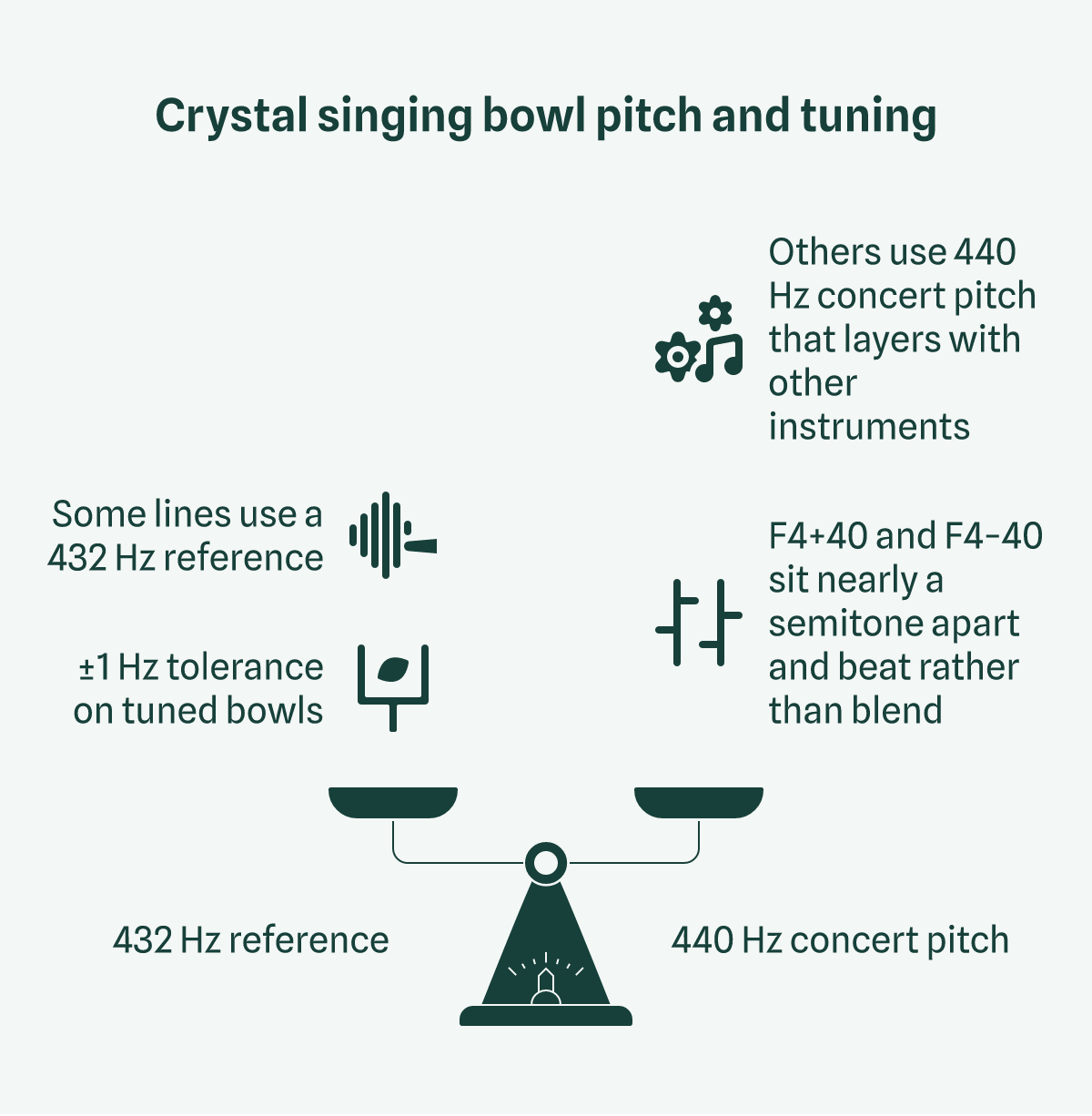
Some lines use a 432 Hz reference (Meinl Sonic Energy, F34, F248), others 440 Hz concert pitch that layers with other instruments (Meinl Sonic Energy). Even reputable makers publish a ±1 Hz tolerance on tuned bowls (mindfulstore.com.au). A bowl marked (A+20) rings about 471.6 Hz, and an F4+40 with an F4−40 sit nearly a semitone apart and beat rather than blend (ravensounds.com).
What I can’t give you
The sources I checked give no verified weight figures and no price band for bowls or sessions, so I am not asserting either here.
What it sounds and feels like in plain language
A crystal singing bowl sounds one clear note, not a wash of tone. Raven Sounds describes crystal bowls as producing “a strong, steady fundamental with a long sustain, often a minute or more from a single strike.” That sustain is why a single hit keeps ringing while you move on to something else.
Above that fundamental sit quieter overtones. In a bowl they don’t line up in a tidy harmonic series, and the bowl’s geometry sets their pattern. That’s why two bowls at the same fundamental can read as glassy or warm. Pitch alone won’t tell you which one you’ll prefer in the room.
Strike versus rim
- Strike: the full bloom of fundamental plus overtones, then a long decay.
- Rim: continuous, controllable output you can swell or ease back.
My pick for a first session is rim play. You can ride the volume instead of committing to a strike and waiting it out.
How it sits in a room
Whether a bowl fits alongside other instruments is a pairing question, not a mood question. Raven Sounds puts it plainly: the number “does tell you how a bowl will sit in a room, how it will pair with other instruments, and where it lands relative to the rest of your set.” Two bowls both labelled F4 aren’t interchangeable. An F4+40 and an F4-40 sit 80 cents apart, nearly a full semitone, and struck together they beat against each other rather than blend. If you play with others, check the note and the cents marking before you buy.
Who it suits / who should skip it
It suits you if you play with others
A crystal singing bowl is a clearly pitched instrument. The 440 Hz lines are built on the standard tuning of music (F1), and Meinl says tuning to 440 Hz means those bowls layer beautifully with crystal instruments (F245). If your set already shares one reference, a crystal bowl slots in as a note, not a texture.
If nobody else is playing, a 432 Hz bowl is fine. Just make the whole set share that reference. The two conventions sit 8 Hz apart at A, and a 432-tuned bowl and a 440-tuned bowl aiming at the “same” note will beat against each other (F156). My rule: pick a reference before you buy a second bowl, not after. That rejects the usual “buy whatever sounds nice” advice, and it’s the reason I would rather own one good bowl in a shared reference than two mismatched ones.
It suits meditation and daily practice
Mid-range frequencies, 200 to 400 Hz, are the most versatile zone, and where most beginners are steered (F191). A medium F or G bowl around 350 to 400 Hz is the most universally pleasant starting point (F193, F200).
Skip it if
You want to improvise alongside other instruments but can’t commit to one tuning reference. See above.
Loud, sustained high ring bothers you. That’s the thing to check before anything else. Crystal bowls sustain for a long time, and the small ones sit highest: 6 to 7 inch bowls run from the upper fourth into the fifth octave (F148). Read the tinnitus FAQ before you buy. If you have tinnitus or hearing concerns, ask your doctor whether sustained high tones are safe for you. Bring the specific question of exposure length and volume.
Where to experience one
I can’t send you to a named venue and call it verified. The engine behind this guide can’t see Sound Dip’s listings, so any venue name I printed here would be unchecked. Start with the city pages instead, then do the checking yourself before you book.
What to confirm before you go
Call or check the session page and ask three things:
- Is a crystal bowl actually played? Many sound baths are gongs and metal bowls only. The stock line or session description should name a crystal singing bowl.
- What size and tuning? Makers publish a diameter ladder from 8” / 20 cm up through 14” / 35 cm (Meinl Sonic Energy), and tuning references of A4 432 Hz on chakra-tuned lines (Meinl Sonic Energy). If the venue can’t tell you, treat the listing as unconfirmed.
- Is the page live and current? Studios close and change formats. A listing that hasn’t been updated recently isn’t evidence of anything.
Reading the answer you get
A room running 440 Hz tuned bowls will layer with other instruments, which is why Meinl notes that “440 Hz is the standard tuning of music.” A room running 432 Hz bowls is a different reference, about 32 cents flat of A440 across the scale (Raven Sounds). Neither is better. Just know which one you are walking into.
If the venue can’t answer the size or tuning question, my advice is to go anyway if the price is low and your only goal is to hear the instrument. Skip it if you are sensitive to long, high sustain and want certainty first.
Buying and owning: sizes, sets, brands, second-hand
Size to note, as published
The Meinl chakra line maps diameter to a labelled note: CSB8C5 Root, C5. CSB8F Heart, F4. CSB8B Crown, B4. CSB9A Brow, A4. CSB10D Sacral, D4. CSB10E Solar Plexus, E4. CSB10F Heart, F4. CSB10G Throat, G4. CSB11F Heart, F4. CSB12C Root, C4.
Notice the repeats. F4 appears at 8, 10 and 11 inches, so a size label alone tells you nothing about pitch. Buy the note, not the diameter.
Sets versus singles
Chakra sets sell as bundles. A 432 Hz set and a 440 Hz set won’t layer. Pick one reference and stay in it.
Brands and second hand
I wouldn’t chase a brand. Tuning tolerance matters more. Even reputable makers publish a plus or minus 1 Hz tolerance on tuned bowls. If a seller can’t name the recorded note, assume nothing. Take a tuner app to any second-hand viewing.
FAQ
What do crystal singing bowls do for you?
They give you a clear, steady tone that’s easy to listen to and easy to play. Crystal bowls tend to produce a strong fundamental with a long sustain, often a minute or more from a single strike, which is why they usually read as a clear note with rich overtones above it. What that tone does for you is a matter of what you notice while listening. Claims about healing frequencies belong with the evidence, not the product page.
How much are crystal sound bowls worth?
There’s no single answer, because worth depends on size, tuning and maker. Single bowls cost far less. Larger bowls use more quartz and are usually the pricier ones. If you’re buying your first, I would spend on one bowl you have heard a recording of instead of a cheap set you haven’t.
Tibetan vs crystal bowls for beginning sound baths/client work?
For client work I would start with a hand-hammered metal bowl in the F or G range, around 350 to 400 Hz. It’s the most universally pleasant starting point and it survives handling better. Crystal bowls are easier to play cleanly and sustain longer, but they’re fragile and loud. Many people assume crystal is the more advanced choice. For a first bowl that gets carried to sessions, metal is the safer pick.
Best brand for singing bowls?
I wouldn’t name one best brand. What matters more is whether the maker measures each finished bowl and labels it with its actual note, which is how Crystal Tones bowls arrive at one shop, with a marking like (A+20). Meinl publishes a tolerance of plus or minus 1 Hz on its tuned bowls. An unlabeled bowl can still sound lovely, but you’re buying the recording, not the number.
Does anyone own singing bowls?
Yes. Shops sell them as instruments for personal practice, and studios buy them too. Meinl’s catalog lists crystal singing bowls, crystal singing chalices, and singing bowl practice sections. Plenty of people own one bowl and play it at home. If you’re unsure, buy one medium bowl first and add more only when you know what you want.
Sources
-
[ How to Choose the Right Frequency for Your Singing Bowl
](https://ravensounds.com/blogs/news/how-to-choose-the-right-frequency-for-your-singing-bowl)
-
[ How to Choose the Right Frequency for Your Singing Bowl
](https://ravensounds.com/en-ca/blogs/news/how-to-choose-the-right-frequency-for-your-singing-bowl)
-
A Guide to Singing Bowl Tones and Frequencies – Mindful Store
-
What Frequency in Hertz Should You Choose for Your Tibetan Singing Bowl?
-
Frosted Crystal Singing Bowls | Shop | Aloka - Sound Bath House