Sound Bath Negative Effects: Risks, Contraindications, and What's Normal
Sound baths are safe for most adults. Here's who should get medical clearance first, what singing bowls can and can't do to your hearing, and which reactions are normal.
Sound baths are safe for most healthy adults. You lie down, listen to instruments like singing bowls, gongs, and chimes, and breathe. Nothing enters your body and nobody manipulates it. The risks come from three sources: high volume, strong low-frequency vibration, and the psychological effects of lying still in a relaxed state. For people with certain medical conditions, those three factors matter more.
This page covers what is known, what is uncertain, and who should talk to a doctor before booking. It also covers the emotional reactions people search for most, like crying or a spike of anxiety. It is not medical advice. If you have a diagnosed condition, treat the sections below as a starting point for a conversation with a clinician, not a substitute for one.
Who should not attend a sound bath?
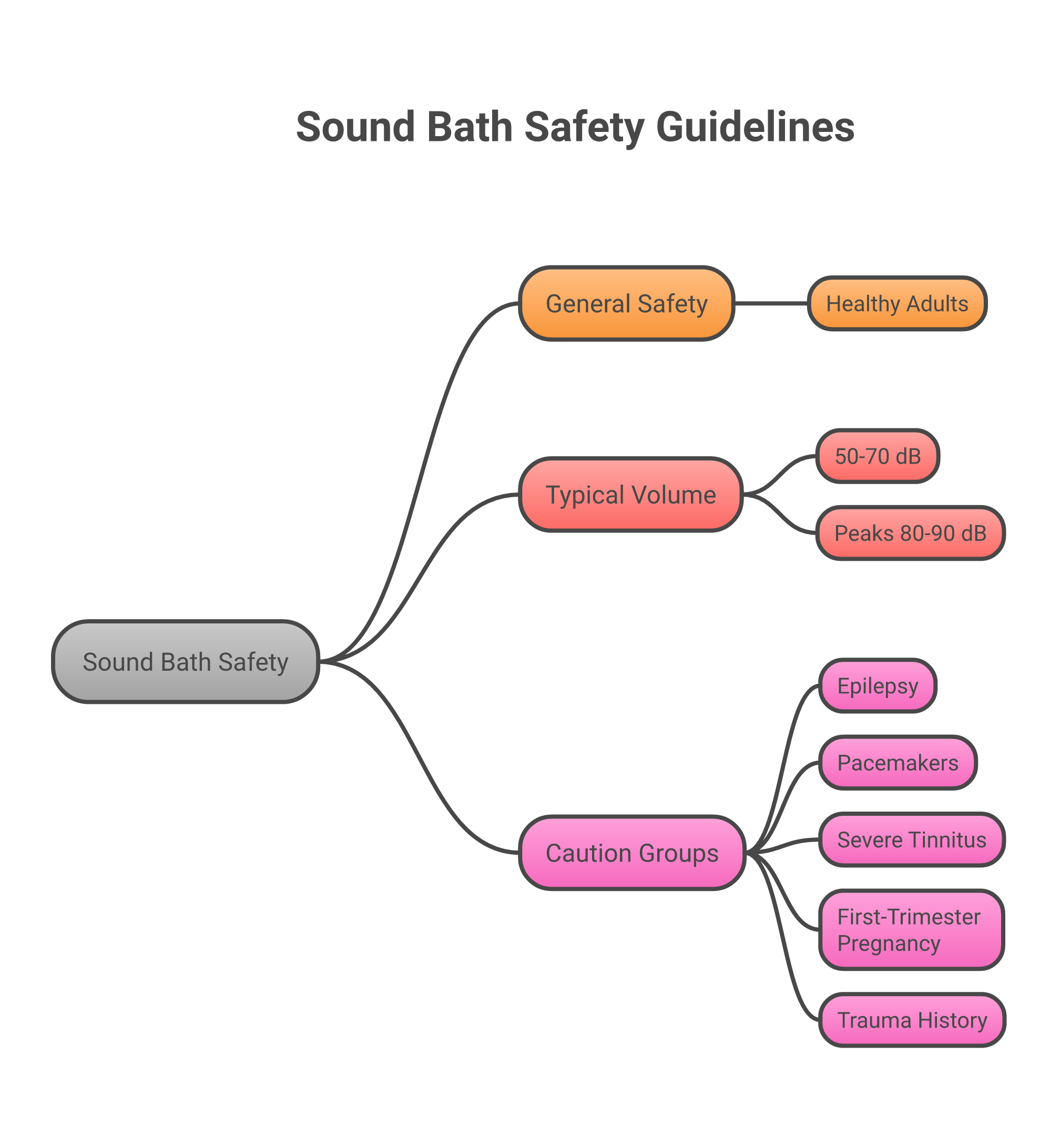
People with epilepsy, implanted electronic devices, severe tinnitus, and certain pregnancy situations should either avoid sound baths or get medical clearance first. The evidence for most of these cautions is thin, and that is worth stating plainly. Sound bath research is small in scale and rarely tracks adverse events. The cautions below come from physiological reasoning, case reports, and practitioner consensus rather than large controlled trials.
Epilepsy and seizure disorders
Reflex epilepsy, a rare form of the condition, can be triggered by specific sensory inputs. The best-documented triggers are flickering light (photosensitive epilepsy) and, less commonly, sudden loud sounds or music (audiogenic epilepsy). Audiogenic seizures have been studied mostly in animal models and in a small number of human case reports. Musicogenic epilepsy, a subtype where specific pieces of music provoke seizures, is described in the medical literature as rare but real.
Sound baths do not usually produce the sudden, startling noises tied to audiogenic triggers. Singing bowls and gongs produce sustained tones that build and fade. Gong baths can include sharp strikes and rapid dynamic shifts, though. The bigger practical concern is sessions that pair sound with flashing lights or strobing visuals, which can affect people with photosensitive epilepsy. If your session includes lighting effects, ask about them directly.
If you have epilepsy, especially a known auditory or musicogenic trigger, speak with a neurologist before attending. The risk is low for most people with epilepsy, but it is not zero. No study has directly measured seizure incidence during sound baths.
Pacemakers and implanted electronic devices
There is no published evidence that singing bowls interfere with pacemakers, defibrillators, or cochlear implants. The concern is theoretical. Strong vibrations and magnetic fields can, in principle, affect some implanted devices. Metal singing bowls are sometimes described as magnetic, but the field strength is far below what would typically matter for a modern pacemaker.
The practical guidance is simple. If you have an implanted electronic device, ask your cardiologist or device clinic before attending. Tell the practitioner too, and ask whether any bowls will be placed on or near your chest. Some practitioners seat people with devices farther from large gongs. This is a precaution, not a documented hazard.
Severe tinnitus
Tinnitus is ringing or buzzing in the ears without an outside source, and loud sound exposure can make it worse. Sound baths usually run at moderate volumes, but gong peaks and close proximity to instruments can exceed comfortable levels for someone with reactive tinnitus. The American Academy of Otolaryngology’s 2014 clinical practice guideline on tinnitus treats sound exposure management as a standard part of care.
For many people, sustained tones make the ringing feel more noticeable for a while, and it settles afterward. If your tinnitus is severe or easily triggered, a sound bath may aggravate it. Tell the practitioner so they can adjust volume and keep bowls at a distance. That is a reasonable compromise, but there is no guarantee.
First-trimester pregnancy
There is no evidence that sound baths harm a first-trimester pregnancy. Many practitioners and prenatal care providers still suggest waiting until the second trimester out of caution. Some avoid placing instruments directly on the abdomen at any stage. The full picture is in the pregnancy section below.
Can a singing bowl damage your hearing?
Only in one specific situation: a metal bowl struck hard, held close to your ear, for a sustained period. That is a real hearing risk, the same way any loud, prolonged sound near the ear canal is. It is not how sound baths work in practice. Practitioners keep bowls at least a few feet from your head, and the strikes that sustain a tone are far softer than the one that starts it ringing. If a practitioner ever brings a bowl within inches of your ear and strikes it repeatedly, say something.
What decibel levels are typical?
Most sound baths run between 50 and 70 decibels. That is roughly the range from normal conversation to a vacuum cleaner at a distance. Peak moments, like a gong strike or a bowl played close to your head, can reach 80 to 90 decibels. For context, the National Institute for Occupational Safety and Health (NIOSH) sets 85 decibels as its threshold for an 8-hour exposure limit. A sound bath rarely holds that level for more than a few seconds.
A typical session is well within safe listening ranges for a healthy adult. The exceptions are a gong struck forcefully near your head, or sitting right beside a large bowl for a long stretch. If a tone feels painful or causes pressure in your ears, move or ask the practitioner to lower the volume. Pain is a reliable sign the sound is too loud for your ears, whatever a decibel meter says.
What about bowls placed directly on the body?
Some practitioners place a bowl on your chest, back, or stomach and strike it there, so you feel the vibration directly. Not every practitioner does this, so ask in advance. For most healthy adults the vibration itself isn’t the risk. The issue is that direct contact isn’t appropriate for people with pacemakers, recent surgery, certain pregnancies, or injuries near the placement site. A practitioner who asks about your health history before placing a bowl on you is doing it right. One who skips that question is a reason to speak up or decline that part of the session.
Are all singing bowls equally safe?
Mostly, yes. A cheap bowl won’t shock you or cut you. Quality still matters, though. Bowls mass-produced and sold as “antique Tibetan” are often uneven in shape and rim thickness. That can mean a wobbly tone, rough edges, or a bowl that doesn’t hold a strike cleanly. None of that is dangerous the way loud volume is. It does mean a weaker, less controlled experience, and a rough rim can occasionally nick skin during a hands-on session. Hand-finished bowls tend to be more consistent and easier for a practitioner to control. For how the two main bowl types differ, read Crystal vs. Tibetan Singing Bowls.
Why do people cry or feel anxious during a sound bath?
This is the most common “negative effect” people search for, and it is usually not a bad sign. Long, sustained tones combined with stillness and closed eyes can lower your guard quickly. Your nervous system drops out of its usual alert state, and whatever you have been holding onto has room to surface: stress, grief, unprocessed emotion. Crying mid-session is common enough that most practitioners expect it and will not interrupt you for it.
A smaller number of people feel the opposite: a spike in anxiety instead of relaxation. This can happen if lying still with your eyes closed feels exposing rather than calming. It can also happen if a particular tone or vibration feels overwhelming. If it happens to you, you can open your eyes, sit up, or leave the room. A good practitioner will have said this at the start.
Neither reaction means something is wrong with you. Both are your nervous system processing input, just in different directions.
Can a sound bath trigger a trauma response?
Yes, and this is the risk that gets discussed least. Lying still in a dim room with your eyes closed and your attention turned inward can surface difficult memories or emotions. This isn’t unique to sound baths. It happens in meditation, yoga nidra, body scans, and other relaxation practices. Research from Willoughby Britton’s lab at Brown University has documented meditation-related adverse effects, including anxiety, re-experiencing of trauma, and dissociation, in a meaningful minority of meditators, especially those with prior trauma.
Sound baths add two variables to the meditation equation: sustained sound and, often, physical vibration. For some people that combination is deeply settling. For others, particularly people with PTSD or a history of dissociation, it can be destabilizing. That doesn’t make sound baths dangerous for trauma survivors. It means the response is possible and worth preparing for.
If you have a trauma history, a few adjustments help. Sit up rather than lying down. Keep your eyes open. Choose a session you can leave at any time without drawing attention. Tell the practitioner beforehand that you may need to step out. A growing number of practitioners are trained in trauma-informed sound work, and it is reasonable to ask about this when you book.
What if you feel shaky or off afterward?
Some people leave a session feeling heavy, teary, or a little disoriented. That isn’t a failure of the session or a sign you did it wrong. A sound bath can leave you deeply relaxed, and coming back to bright lights, conversation, and traffic right afterward can feel jarring. Give yourself a slow exit. Stay lying down an extra minute, drink water, and avoid scheduling anything demanding right after. Most of this fades within an hour or two. For the full first day, read What to Expect After a Sound Bath.
What are the signs a session is not going well?
Act on these signals rather than pushing through:
- Ear pain, pressure, or ringing that starts during the session
- Nausea, dizziness, or a feeling of faintness
- Rapid heartbeat, shortness of breath, or a sense of panic
- Intrusive memories, flashbacks, or a feeling of leaving your body
- Numbness, cramping, or sharp pain from lying in one position
- A strong urge to cry that feels overwhelming rather than releasing
If any of these happen, change position, open your eyes, and leave the room if you need to. Most practitioners expect this and won’t be offended. A good facilitator tells you at the start that you are free to move, sit up, or step out at any time. If yours didn’t, that is worth noting.
A passing wave of emotion is normal. A flashback, a sense of leaving your body, or distress that lingers for days rather than fading is not. In that case, step back and get support rather than pushing through another session.
Are sound baths safe during pregnancy?
Sound baths are generally considered safe during pregnancy, but the trimester matters, and the evidence is limited. No research directly examines sound bath outcomes in pregnancy. The guidance below comes from general principles of prenatal sound exposure and practitioner consensus, not controlled studies.
First trimester
Many practitioners and prenatal providers suggest waiting until the second trimester. The reasoning is caution rather than evidence. Miscarriage risk is highest in the first trimester for reasons unrelated to sound. If a loss happens after a sound bath, the association can be distressing even though no causal link exists. Some practitioners also avoid strong low-frequency vibration near the pelvis in early pregnancy. There is no data showing harm, and no data showing safety, so the conservative choice is to wait.
Second and third trimesters
Sound baths are commonly attended in the second and third trimesters, with two standard adjustments. First, lying flat on your back for a long time can compress the vena cava, the large vein returning blood to the heart, and cause dizziness. That is why prenatal providers recommend side-lying or propped positions after about 20 weeks. Most venues can set you up on your side with bolsters. Second, many practitioners avoid placing singing bowls directly on the abdomen. Whether bowl-on-belly vibration affects the fetus is unknown, and the precaution is easy to take.
If you are pregnant, tell the practitioner your trimester and ask about positioning. A session designed for prenatal attendees will have bolsters, side-lying options, and lower volumes.
Are sound baths safe for children?
Sound baths are generally safe for older children and teenagers who can lie still and follow instructions. They are not designed for young children. The main issues are volume tolerance, attention span, and whether the child can communicate discomfort. Children’s ears are more sensitive to loud sound than adults’ ears, and early noise exposure can add up to hearing damage over time.
For children under about 10, a sound bath usually isn’t a good fit unless it is built for kids, with lower volumes, a shorter session, and instruments played at a distance. For teenagers, a standard session is usually fine if they want to be there. Most studios want a parent or guardian in the room for anyone under 18, and many require it.
How long is too long for a sound bath?
Most sound baths run 45 to 90 minutes, and that range is fine for healthy adults. There is no established point at which a session becomes unsafe. The limits are comfort and attention, not physiological risk. Lying still on a hard floor for 90 minutes can cause back pain, numbness, or restlessness, especially if you have an old injury.
If you are new, a 45-minute session is a reasonable start. Our beginner’s roadmap for the first five sessions keeps the early ones short and low-commitment. Some communities offer overnight or multi-hour formats. These aren’t inherently dangerous, but they stretch the window for the trauma and discomfort issues above. For any extended session, make sure you can leave, change position, and talk to the practitioner throughout.
What to ask and disclose before you book
Disclose any relevant medical condition when you book, not when you arrive. Most studios have a health intake form or ask in the booking flow. If they don’t, email or call. Conditions worth mentioning include epilepsy or any seizure history, implanted electronic devices, pregnancy and trimester, severe tinnitus or hearing loss, recent surgery, PTSD or a trauma history, and anything that makes lying flat uncomfortable.
A short list of questions covers most of what matters:
- Are you trained or certified, and by whom?
- Will any bowls touch my body during this session?
- How close will bowls come to my head?
- Do you need to know about any health conditions beforehand?
- What should I do if I feel dizzy, anxious, or overwhelmed partway through?
A practitioner who answers clearly, asks follow-up questions, and offers positioning alternatives is worth booking with. One who brushes off the questions or claims sound baths carry no risk is one to avoid, however popular their sessions are. Our guide on how to choose a sound bath practitioner goes deeper on vetting.
Finding a practitioner who takes safety seriously
Sound Dip lists practitioners by city, and many listings include intake processes, training background, and session formats. In a major metro, start with the Los Angeles sound bath directory or the New York City sound bath directory. For a smaller market with a dense sound healing community, the Asheville directory is a good starting point.
If you are new to the practice, What Is a Sound Bath? covers what happens in a session. For the evidence base, Sound Bath Benefits: What the Research Actually Shows reviews the studies, and Sound Healing for Anxiety focuses on anxiety outcomes. None of these replace a conversation with your doctor if you have a condition that concerns you.
The bottom line
The negative effects people actually report are mostly emotional: tears, a brief spike of anxiety, or an unsettled hour afterward. They are usually manageable and usually temporary. The physical risks are real but narrow: hearing strain from close, loud, sustained sound, and specific cautions for epilepsy, implanted devices, severe tinnitus, and early pregnancy. The people who run into trouble are usually the ones who skipped the conversation with the practitioner beforehand.