The Monochord: The Drone Instrument You've Heard but Never Named
Most sound baths get their endless drone from a monochord, a wooden sound box with strings stretched across it.
Most sound baths get their endless drone from a monochord, a wooden sound box with strings stretched across it. If you’ve sat in a room while a low hum seemed to fill the space and never stop, you were probably hearing a monochord and not a gong or a singing bowl. The instrument is old and simple, and that’s what makes it a good first purchase for anyone who wants to make drone sound at home.
Monochord spec box
| Spec | What the sources give |
|---|---|
| String count | 1 in the classical form. Modern instruments run from 10 to 60 strings, per Musicmakers. |
| Body size | 720 mm x 90 mm x 80 mm on the 3B Scientific model. 32 1/2” x 9” x 4” body depth on the James Jones 25 string model. |
| Weight | 8 pounds on the Musicmakers monochord with gig bag. |
| Tuning | 440 hz as standard from James Jones, with the option to change to 432 hz. |
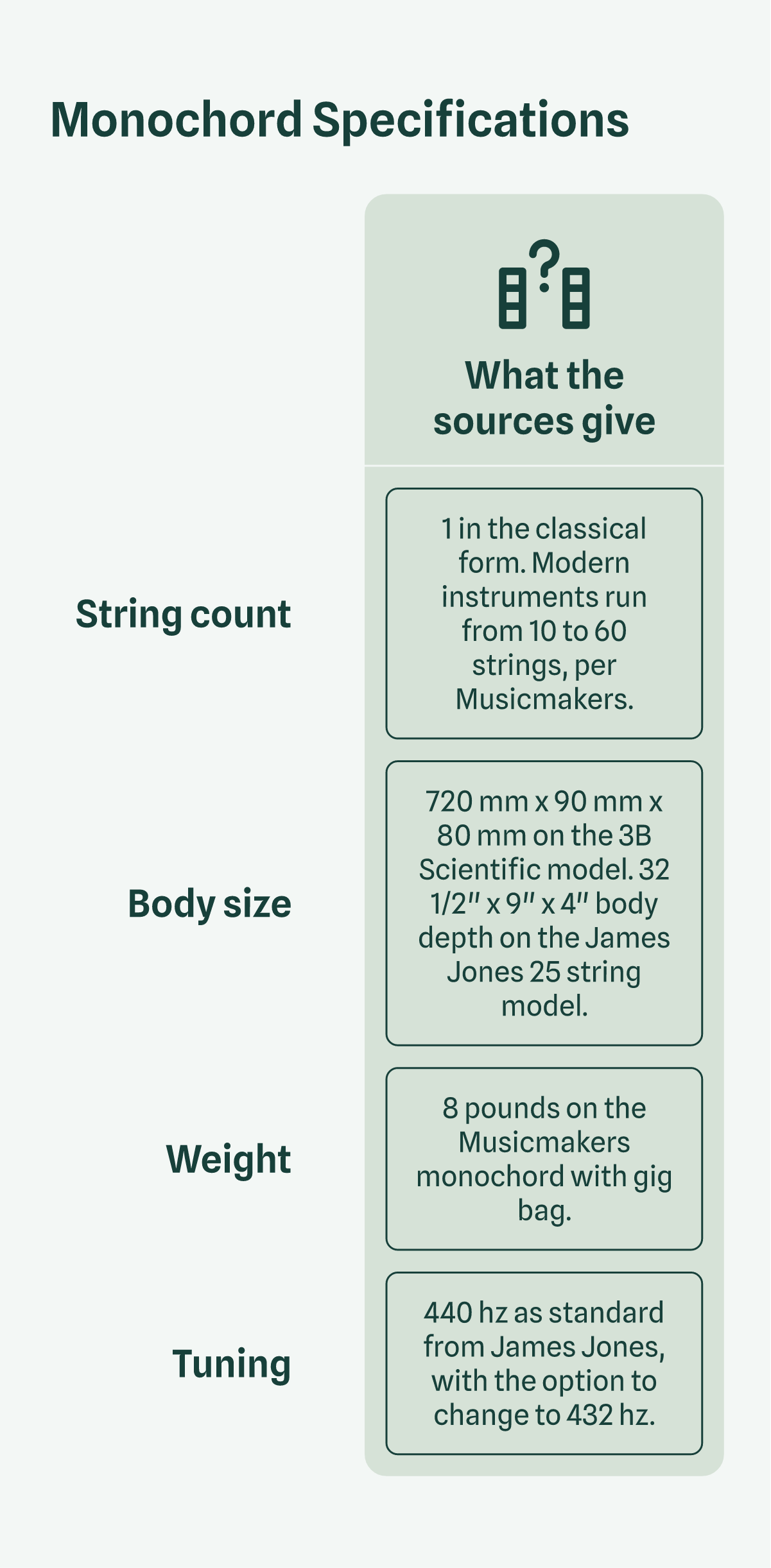
A note on that table. The numbers come from different instruments built for different purposes, so they don’t describe one product. The 600 mm scale length belongs to a physics teaching monochord with two steel strings and a nylon string, sold to schools. The 8 pound figure belongs to a kit-built instrument from Musicmakers. Treat the table as a map of the category, not a comparison of rivals.
String count
The name says one string, and the original instrument had one. Britannica describes the monochord as a musical instrument consisting of a single string stretched over a calibrated sound box with a movable bridge. The Whipple Museum at Cambridge dates that design to around 500 BC, when it was used for the investigation and demonstration of musical phenomena.
The modern instrument kept the name and dropped the single string. Musicmakers describes the modern monochord as a rectangular sound box with anywhere from 10 to 60 strings stretching across the entire length. James Jones builds a 25 string version and states plainly that it can’t exceed 25 strings. KlangWerkstatt Deutz builds a 24 string model, a 13 or 16 string model, and a bass monochord with 20 brass strings or 32 steel strings.
Frequency range and tuning
A monochord doesn’t sweep through a frequency range the way a synthesizer does. It sits on a chord and stays there. James Jones gives a worked example: a monochord tuned in the key of C would have 5 strings at C4 (middle C), 4 strings at G3, 9 strings at C3, 3 strings at G2, and 4 at C2, for 25 strings in total. All 25 notes come from two chords, C and G, spread over three octaves.
The tuning reference is 440 hz by default. James Jones notes that you can change it to 432 hz if you want to. I wouldn’t pay extra for that. The gap between the two references is small, and no source I read ties either one to a health outcome. The choice is a matter of preference, not function.
Volume
The sources don’t give a decibel figure for any monochord, and I won’t invent one. What they do say is qualitative. KlangWerkstatt Deutz describes its bass monochord as having outstanding tonal fullness in proportion to the body volume. Simon Fraser University’s demonstration notes that the details of a monochord can’t be seen in a large lecture hall but the sound can be clearly heard. That’s a fair summary of the instrument’s character. It’s not loud the way a drum is loud. It’s continuous, and continuity is what makes it feel like it fills a room.
Price band
That’s the only full price list in the sources I read, and it’s one maker’s list.
What a monochord sounds like
It sounds like a held note that doesn’t resolve. Pluck or bow the strings and you get a chord instead of a melody, and the chord keeps ringing while you play it again. Because the strings are tuned to a small set of notes across several octaves, any combination you play lands inside the same harmony. There’s no wrong note to hit.
That’s the whole reason sound sessions use it. A facilitator can play continuously for a long stretch without needing to think about what comes next, and the room never drops into silence. A gong creates peaks and decays. A monochord creates a floor. If you have been in a session where the drone seemed to start before you settled and was still going when you opened your eyes, that was the instrument doing the one thing it does well.
The physics isn’t mysterious. The 3B Scientific instruction sheet states that the monochord demonstrates how the pitch of the sound produced by vibrating strings depends on their tension, length and thickness. Move a bridge, change the length, and the pitch changes. The classical instrument used exactly that property to work out musical intervals. The modern instrument uses a fixed set of strings so the intervals are already chosen for you.
One historical note is worth knowing, because it explains why the instrument feels the way it does. The Whipple Museum records that until at least the 17th century, astronomers such as Johannes Kepler believed the planets moved in such a way as to produce a kind of cosmic harmony. The monochord was the tool used to reason about that harmony. The modern instrument isn’t making a cosmic claim. It’s making a continuous chord. But the association is where the word drone gets its weight.
Who a monochord suits, and who should skip it
It suits you if you want a drone instrument you can play without training. There is no fingering to learn and no melody to remember. You bow or pluck, and the instrument holds the harmony for you. It also suits anyone running group sessions who needs continuous sound while attention is elsewhere.
It suits you if you want to play for yourself at home. That isn’t nothing, but it’s in the same territory as a mid-range singing bowl set, and it produces far more continuous sound.
I would skip it if you want to play melodies. A monochord is a chord machine. If you want to pick out tunes, buy a harp or a lyre instead. The KlangWerkstatt Deutz 13 or 16 string model can be fitted with bridges and played as a melody instrument like a Japanese koto, but that is a conversion, not the default.
Here’s the opinion I’ll defend against common advice. If you’re buying your first drone instrument and you’re torn between a monochord and a larger set of singing bowls, I would buy the monochord. Common advice says start with bowls because they’re cheaper per piece and easier to store. My reason for going the other way: a monochord produces continuous sound from a single action, while bowls require you to keep striking or circling them to sustain anything. If your goal is a drone, buy the instrument that drones. If you want a collection of individual tones, buy the bowls.
The second opinion will annoy some people. Don’t buy a monochord because of a frequency claim. I read the maker pages and the museum pages, and none of them make a health claim about 432 hz or any other tuning. The instruments are sold as instruments. If a seller tells you a specific tuning treats a specific condition, that seller is going beyond what the sources support, and you should ask them for the study.
Safety and practical questions before you buy
A monochord is a wooden box under string tension, so the practical questions are about the instrument rather than your body. Ask the maker what the body depth is, since a deeper box weighs more and takes up more space. Ask whether the instrument ships tuned or whether you tune it yourself. James Jones notes that these instruments involve the very accurate tuning of 25 strings, which is a real task and worth knowing about before the box arrives.
If you have a hearing condition, tinnitus, or any concern about prolonged exposure to continuous sound, that is a question for your doctor rather than for a maker. Take these questions with you: is sustained exposure to a continuous drone at moderate volume a problem for my condition, is there a volume or duration I should stay under, and are there frequencies I should avoid. I can’t answer those, and neither can a product page.
One ordering detail. James Jones notes that a monochord in F or G is 2” shorter and usually has to be ordered, with a couple of weeks allowed. If you want a specific key, plan for the wait.
Listings featuring monochords
I have to be straight with you here. Monochords appear in far fewer session listings than gongs or singing bowls. The reason is simple economics. A facilitator can build a varied session around a handful of bowls, but a monochord is one large instrument that does one job, and it costs more than a single bowl. Many sessions that do use one list it as part of a general instrument set rather than naming it.
That means the sample is small, and I am not going to pretend otherwise. I can’t see Sound Dip’s verified listings, so I can’t tell you which venues near you own one or name any venue as verified. What I can tell you is how to find out.
Start with the city pages, which list what is running in your area. When you find a session that interests you, message the facilitator and ask one direct question: do you use a monochord, and if so, how many strings does it have. A facilitator who owns one will answer immediately and probably with enthusiasm. A facilitator who doesn’t may still have one on a backing track, which is a different experience and worth knowing about before you book.
If you find a session that names a monochord in its description, treat that as a good sign. It means the facilitator knows what is in the room and cares enough to say so.
FAQ
Is a monochord the same as a sonometer?
Almost. Harvard’s Natural Sciences Lecture Demonstrations states that if there is just one string, it’s known as a monochord, and the sonometer is the version with more than one string. In practice the two words get used interchangeably for the laboratory instrument, and the Harvard page notes that the monochord illustration in its materials comes from John Tyndall’s book Sound, published in New York in 1867. For a buyer, the distinction doesn’t matter. For a physics department, it does.
How many strings does a monochord have?
The classical instrument has one, which is where the name comes from. Britannica describes it as a single string over a calibrated sound box with a movable bridge. The modern instrument has many. Musicmakers gives a range of 10 to 60 strings. James Jones builds 25 and states that it can’t exceed 25. KlangWerkstatt Deutz builds 24 string, 13 or 16 string, and 20 or 32 string bass versions. If a listing doesn’t say how many strings, ask.
Can I retune a monochord to 432 hz?
Yes, according to James Jones, who tunes his instruments to 440 hz by default and notes that you can easily change it to 432 hz. Whether you should is a separate question. I wouldn’t rebuild a purchase decision around it. No source I read supports a health claim for either reference pitch.
Is a monochord hard to play?
No, and that’s its main appeal. You don’t need to learn fingering or melody. The difficulty is in tuning, not playing. James Jones describes the process as involving the very accurate tuning of 25 strings. That’s the part that takes patience.
How much should I expect to pay?
Larger European instruments with longer scale lengths use more material and generally cost more, though the sources don’t give a figure for them.
Do I need a pickup?
Only if you want to amplify the instrument or record it directly.
Where can I hear one before buying?
Look for a sound session in your area that uses drone instruments, and ask the facilitator directly whether a monochord is part of the setup. If you’re near a university with a physics department, the instrument also turns up in lecture demonstrations, since it exists to show how string length, tension and thickness change pitch. The Whipple Museum in Cambridge holds a 19th-century example from the Wheatstone laboratory at King’s College London, and a monochord for experiments in acoustics dated circa 1870 is listed at 645 mm long, 79 mm wide and 142 mm high. Museums are a quiet way to see one up close before you commit.
Sources
-
[