Tuning Forks in Sound Therapy: Weights, Frequencies, and Session Uses
A tuning fork is a metal U-shaped instrument that produces a pure tone when struck, and tuning fork sound therapy uses that tone in relaxation sessions.
A tuning fork is a metal U-shaped instrument that produces a pure tone when struck, and tuning fork sound therapy uses that tone in relaxation sessions. The fork itself is simple. The choices around it aren’t. Weighted or unweighted, which frequency, how long it rings, and whether it touches the body at all. I read the manufacturer specs, the acoustics literature and the clinical directions for use so you can pick a fork without guessing.
Spec box: weighted vs unweighted, frequency options, price band
Weighted forks carry small brass weights on the tines. The weights slow the vibration, which lowers the pitch for a given tine length and makes the fork feel more active in the hand. Unweighted forks are bare metal. They tend to ring longer and produce a cleaner, quieter tone.
The Sound Therapy Shop measured ring times on two pairs. Mid-Om forks ran 48 seconds for the American Biosonics fork and 39 seconds for the Indian fork. Unweighted C forks ran 42 seconds for Biosonics and 32 seconds for the Indian fork. So in that shop’s testing, the weighted mid-Om pair sustained longer than the unweighted pair, and the American-made fork outlasted the Indian-made one in both cases.
Frequency is the other half of the spec. Common options include 136.1 Hz, sold as mid-Om, and 256 Hz, the note C. Gongs Unlimited recommends a 64 Hz weighted body fork and a 128 Hz weighted fork, and for unweighted work suggests a trio at 465 Hz, 787 Hz and 880 Hz alongside a 432 Hz fork. Inner Sound sells a set of 13 pair frequencies for practitioners who want a full range rather than one tone.
Accuracy matters more than marketing. The Sound Therapy Shop states that “An Indian tuning fork is guaranteed an accuracy of +/-0.25%” and adds that “We have found that both types of tuning forks normally fall within the accuracy range of +/-0.25%.” In its own test, an unweighted 256 Hz C fork measured 256 Hz for the Biosonics fork and 256.5 Hz for the Indian fork, an accuracy of 0.18%.
One physics note that explains why cheap forks can drift. A 2020 article in Acoustics Today reports that the frequency of a steel fork decreases by 0.01% for every 1°C increase in temperature. That is tiny. It matters if you leave a fork in a hot car, not if you carry it between rooms.
Expect a wide price band. Single forks sit at the low end. A set of 13 pairs is a different purchase from one 256 Hz fork, so compare like with like before you decide a shop is expensive.
How practitioners use them: on-body and off-body
A fork gets used in two distinct ways during a session. They aren’t the same thing.
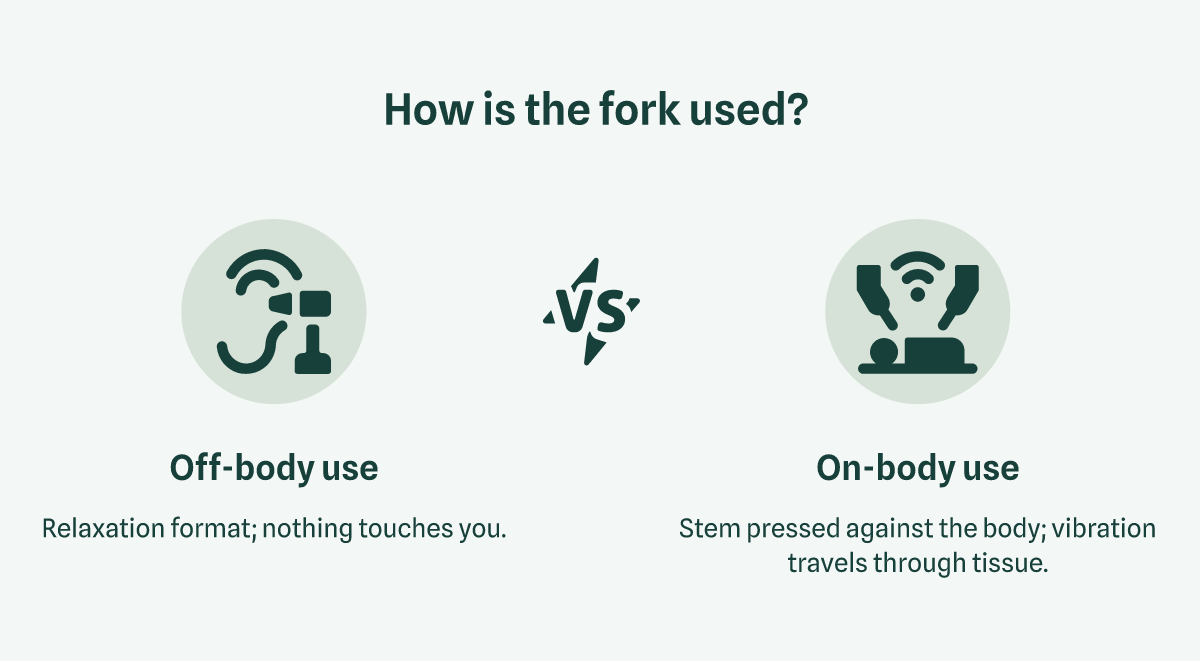
Off-body use is the relaxation format. The practitioner strikes the fork and holds it near your ear, sometimes moving it slowly closer and away. Inner Sound’s own session demo shows exactly this, “practitioner holding 2 tuning forks, activating them and bringing the pair up to the ears and then away.” Nothing touches you. You hear the tone and feel the air move. This version fits comfortably inside a sound bath or a quiet seated session.
On-body use means the stem of the fork is pressed against the body, often on a bony point, so the vibration travels through tissue. Here the territory changes. The moment a practitioner applies a device to a body for a stated physical purpose, you’re close to clinical practice, not relaxation. Physiotherapists have their own version of this. A 2014 study in Multidisciplinary Respiratory Medicine describes tuning forks built for bronchopulmonary hygiene, applied “at an angle of 90° directly on the chest wall of the patient after pulmonary auscultation for location of secretions.” Those forks aren’t the ones in a spa kit. The 15 Hz model weighs 842 g and measures 626 mm in total length. The 20 Hz model weighs 608 g and measures 630 mm.
If you want on-body work for a health reason, talk to a licensed clinician instead of booking a relaxation practitioner. For the line between the two, the Music Therapist comparison is the one to read.
Medical testing shows the same split. Rinne and Weber tests use tuning forks at 256 Hz and 512 Hz, and the Acoustics Today article notes their clang modes near 1,600 Hz and 3,200 Hz land where human hearing is most sensitive. The Rydel-Seiffer directions also cover ear work, telling the user to “Place tuning fork in about 3-4 cm next to the outer ear canal” in cases of ear disease. That’s a diagnostic procedure with a set distance and a set purpose. It’s not a relaxation technique, and you shouldn’t copy it from a blog.
How often do you use one? The sources I read give no standard schedule. Practitioners space sessions the way they space any relaxation appointment. I wouldn’t chase a frequency count. If a session leaves you wired instead of settled, space them out.
Who it suits and who should skip it
Tuning fork sound therapy suits people who find steady, pure tones easier to rest with than music or guided speech. One tone, no melody, nothing to follow. If you like drone-based sound baths, this is the same pleasure in a smaller package.
It also suits anyone who wants a low-commitment first try. A single fork costs little, needs no electricity and takes up no space. You can hear whether the format works for you before booking anything.
Skip it if you want physical results. Tuning forks don’t treat pain, inflammation, fractures or hearing loss. On the pain question, I would say this plainly. The research I read doesn’t support forks as a pain treatment, and anyone selling you a fork for pain relief is selling past the evidence. That runs against a lot of what you’ll read in wellness forums, and I would rather you hear it here.
Skip the on-body version unless a licensed clinician is doing it for a clinical reason. The bronchopulmonary work in that 2014 study used purpose-built devices of 608 g and 842 g applied to the chest wall after auscultation. A 136.1 Hz weighted fork from a spa kit isn’t that device and a relaxation practitioner isn’t that clinician.
One more thing to check before any vibration-based session. If you have a pacemaker or another implanted device, ask your doctor about vibration proximity first. The pacemaker FAQ covers the question properly.
If you’re not sure whether a practitioner is offering relaxation or something closer to treatment, just ask them. Their answer tells you which one you’re booking.
Where to find sessions with tuning forks
I can’t point you at specific venues. I don’t have access to Sound Dip’s verified listings, and I won’t guess at names. The reliable route is the city pages, which list what’s actually running near you. Search your city, then read each listing for the words that tell you what kind of session it’s.
Look for phrasing about holding forks near the ears, about pairs of forks, about a set of frequencies. That’s off-body relaxation work. If a listing mentions placement on the body, ask what training the practitioner holds before you book. One question sorts the offers quickly.
The instrument census is worth a look if you want to see how tuning forks sit alongside other instruments in the wider sound session world. If a term in a listing is unfamiliar, the glossary entry explains the vocabulary in plain language.
FAQ
Can I do tuning fork therapy on myself?
Yes, for the off-body version. You can strike a fork and hold it near your own ear. That’s the relaxation format and it needs no training. What you can’t safely do alone is on-body work aimed at a health problem. The 2014 bronchopulmonary study applied its forks to the chest wall only after auscultation by a clinician. If your reason for using a fork is a symptom, see your doctor instead of self-treating.
What is the best tuning fork frequency for healing?
There’s no best frequency for healing. The sources I read don’t establish forks as a healing treatment. What exists is a set of conventional choices. Gongs Unlimited recommends a 64 Hz weighted body fork and a 128 Hz weighted fork, and Inner Sound sells a set of 13 pair frequencies. Pick by what sounds and feels right to you, not by a healing claim.
Do doctors still use tuning forks?
Yes, in specific tests. Tuning forks at 256 Hz and 512 Hz are frequently used for Rinne and Weber tests, which assess hearing, according to the Acoustics Today article. The Rydel-Seiffer directions also describe placing a fork about 3-4 cm next to the outer ear canal in cases of ear disease. These are diagnostic uses with defined procedures, not therapy.
Where do you put tuning forks for healing?
You don’t put them anywhere on the body for relaxation. The practitioner holds them near your ears and moves them closer and away, as shown in Inner Sound’s session demo. On-body placement belongs to clinical work. The 2014 study applied its forks at 90 degrees directly on the chest wall after a clinician located secretions by auscultation. Ask your doctor before any on-body use.
Will these tuning forks work? (cheaper option)?
Usually yes, if the accuracy holds. The Sound Therapy Shop states that “An Indian tuning fork is guaranteed an accuracy of +/-0.25%” and that both types normally fall within that range. In its test, a 256 Hz Indian fork measured 256.5 Hz, an accuracy of 0.18%. The trade-off is ring time, where the Indian forks ran shorter in that shop’s measurements.
Sources
- PDF The Tuning Fork: An Amazing Acoustics Apparatus
- 481121-rydel-seiffer-medical-turning-fork-arno-barthelmes-directions-for-use
- A new tuning fork with different vibration frequencies as an aid to bronchopulmonary hygiene physiotherapy | Multidisciplinary Respiratory Medicine | Full Text
- Tuning Fork Quality | The Sound Therapy Shop USA
- INNER SOUND Tuning Forks for Relaxation & Stress Reduction | Premium Sound Therapy Tools
- What’s the Difference Between Weighted and Unweighted Tuning Forks? - Gongs Unlimited
- What Is Tuning Fork Therapy? Read This!
- Acoustic Analysis of Used Tuning Forks